
Butterfly Valve Structure and Working Principle
Butterfly Valve Definition: The standard GB/T 21465 defines a butterfly valve as follows: A butterfly valve is a valve whose opening and closing element (butterfly plate) is driven by the valve stem and rotates around the axis of the valve stem. The opening and closing element of a butterfly valve is a disc-shaped butterfly plate. Like a ball valve, a butterfly valve opens and closes rapidly; generally, a rotation of approximately 90 degrees of the valve stem is sufficient to fully open or close the valve.
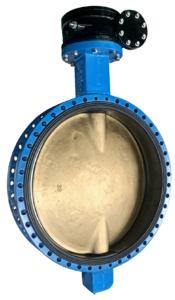
Butterfly valves are widely used in general industries such as petroleum, chemical, power, metallurgy, city gas, city heating, and water treatment, mainly for shut-off or regulation purposes.
Butterfly Valve Working Principle: The basic structural diagram of a butterfly valve is shown above. It mainly consists of a valve body, butterfly plate, valve stem, valve seat (sealing ring), packing, packing gland, support, and handle (or other driving device). Its working principle is simple: a certain torque is applied to the upper end of the valve stem using a handle or other driving device and transmitted to the butterfly plate, causing the butterfly plate to rotate 90° around the valve stem axis, thus completing the full opening or full closing of the butterfly valve. When the valve is fully open, the butterfly plate occupies a certain flow cross-section, reducing the passage and increasing the valve’s fluid resistance.
Structural Features of Butterfly Valves
Butterfly valves have the following advantages:
1) Small size and light weight; compared with gate valves of the same pressure rating and nominal size, the basic weight can be reduced by 30-50%.
2) Simple structure and rapid opening and closing. Butterfly valves have fewer parts and a compact structure; opening and closing only requires rotating the butterfly plate 90°.
3) Good sealing and regulating performance, and can achieve staged flow control.
4) Low fluid resistance and operating torque. Butterfly Valve Classification Methods
Butterfly valves come in many types. Based on their structural characteristics and applications, they can generally be divided into two main categories:
1) Sealed Butterfly Valves: This type of butterfly valve guarantees a complete seal when closed and can be used for shut-off in pipelines. Its sealing pair can use a soft seal (rubber or plastic) or a metal seal structure, or a core structure. Sealed butterfly valves with a metal seal structure often employ a double or triple eccentric structure. Common metal-sealed butterfly valves include multi-layer triple eccentric metal seal structures, U-shaped elastic seal ring metal-sealed butterfly valves, and high-performance metal-sealed butterfly valves.
2) Non-Sealed Butterfly Valves: Non-sealed butterfly valves cannot guarantee a complete seal when closed. Their leakage should meet ISO 5208 Class B, C, or D, or FCI 70-2 (ASME B16.104) Class II, II, IV, or V. This type of valve is used for regulation in pipelines or in pipelines where sealing requirements are not stringent. Its sealing pair material is usually a metal seal structure.